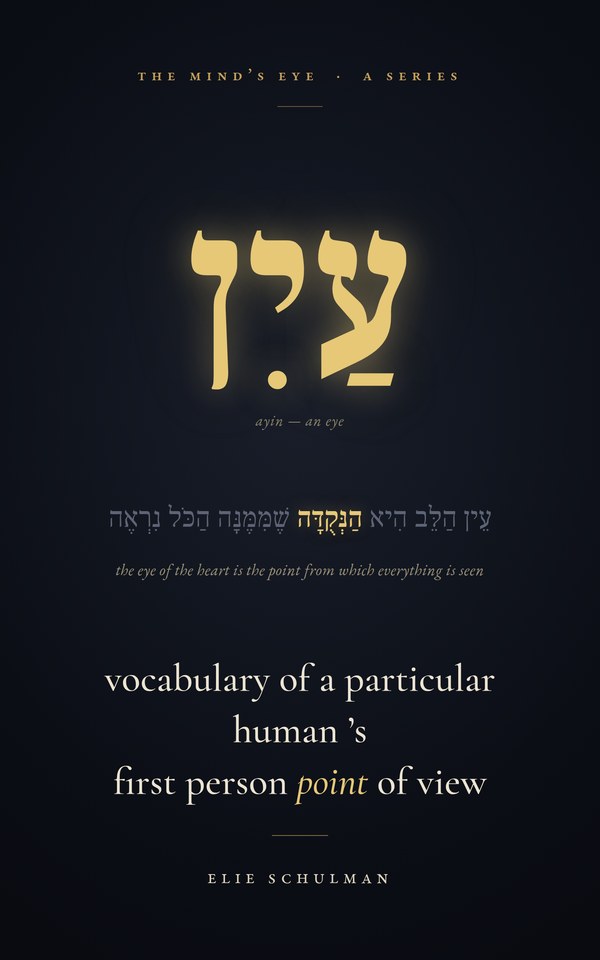
עין הלב היא הנקודה שממנה הכל נראה
The eye of the heart is the point from which everything is seen.
A Word Before: Ein HaLev
This book runs on one term, so take it now, before anything else.
Ein HaLev. עין הלב. The eye of the heart.
Say it plainly first: ayin is an eye. Lev is the heart. The eye of the heart is the inner point from which your attention actually looks.
Not a metaphor for feelings. That is the first mistake people make with the phrase, and the book does not recover if you make it. The Ein HaLev is not where you get sentimental. It is where you get aimed.
Try this. Close your eyes and think of your kitchen. Something appeared. Not on your retina — your eyes are closed. Something in you looked, and something in you saw. Whatever did the looking, that is the eye this book means. Wherever the looking happened from — that point, that exact interior address — is the Ein HaLev.
You have been using it all day. You used it to read this sentence, because reading is not done by the eyes alone. The eyes deliver ink shapes. Something behind them turns ink into a kitchen, a grievance, a plan for Tuesday. The eyes are hardware. The Ein HaLev is the one watching the screen.
Here is the rule the whole book obeys, and I want it on the table before the title gets taken apart:
Wherever this book says point, it means this point. Wherever this book says view, it means what this eye sees.
So when the title says point of view, it is not talking about opinions. It is not talking about camera angles or narrators or the thing your English teacher diagrammed. It is naming a location and what is visible from it. The point is the Ein HaLev. The view is the seeing it does.
One more thing about the heart. Lev, in the vocabulary this book comes from, is not the valentine organ and not the seat of mush. The lev is where attention, intention, and understanding live together — the core of a person that thinks and wants at the same time. So the eye of the heart is not the eye of your emotions. It is the eye of your whole inner person. What it looks at, you attend to. What it never looks at, for you, might as well not exist.
That last sentence is the book. Everything after this page is just taking it apart, one word at a time.
The title has a strange gap in it — human ’s — and the gap is not a typo. Every word in that title earns its own chapter, including the two letters most people read past. Nine words, nine doors.
Start with the first one.
Part: Part I · Nine Words
The title is not a title. It is a sentence taken apart, and each word is a door.
Chapter 1 · vocabulary
Nobody speaks a language. Not the whole thing. You speak a few thousand words of one, and which few thousand is not an accident.
The dictionary is not your vocabulary. The dictionary is everyone’s storehouse; your vocabulary is what you actually carry. It is the working set — the words that come when you reach without looking. And a working set is a record of work. You carry the words for the things you handle.
Listen to anyone for an hour and you will hear the shape of their days. A carpenter’s hour has plumb and proud and out of square in it. A daf learner’s hour has machlokes and shittah and how do we know. A person in pain has an hour full of weather — pressure, waves, something coming. None of them chose those words that morning. The words are sediment. They settled out of years of attention.
That is the claim of this chapter: vocabulary is where attention leaves a residue.
You only keep words for what you keep looking at. A word you never need goes soft and drops away — ask anyone what they remember from tenth-grade chemistry. A word you need daily gets worn smooth and splits into finer words, the way anyone who cares about anything ends up with distinctions their friends cannot hear. People who love coffee do not say bitter. They say ashy, roasty, burnt at the finish. The finer the vocabulary, the longer the eye has rested there.
So a person’s word-hoard is a map. Not of the world — of their looking. Every entry says: the eye came here often enough to need a handle.
And it runs the other way too, which is less comfortable. The words you have do some of your seeing for you. Walk through a forest with a forester and you will watch him see ladder fuels and snags where you see trees. He is not smarter than you. He is worded where you are wordless, and the wording lets his eye grab what yours slides off. Where you have no word, your view has a smooth spot. Not a blind spot — you can still look — but nothing catches.
This is why the book starts here. Before we can talk about a point of view, we need the evidence for one, and vocabulary is the evidence. You cannot audit another person’s inner life. You can hear their words. The words are the visible wake of an invisible ship — the trail the Ein HaLev leaves as it moves through a life, resting here, returning there, never once landing somewhere else.
So the title’s first word is a claim about method. If you want to know where a particular human’s inner eye has been, count their words. What they name finely, they have watched closely. What they have no word for, their eye has never held.
Your vocabulary is not what you know. It is where you have looked.
Chapter 2 · particular
The title does not say the human. It says a particular human, and the little word a is doing the picking.
A human — one, indefinite, could be anyone. Then particular slams the door on “anyone.” One human, picked out of everyone, unrepeatable. The grammar performs the point before the chapter can make it: you start with the whole species and end up holding a single case.
Here is what most people believe about particularity, usually without noticing they believe it: that it is a limitation. The general view would be better — the view from nowhere, the objective one — and a particular perspective is what you are stuck with instead. Particularity as a defect of access. If only you could get outside your one vantage, you would finally see properly.
This chapter says the opposite. Particularity is not a limit on perspective. It is what makes there be a perspective at all.
A view has to be from somewhere. Delete everything particular about a human — the year they were born, the language they were handed, the city, the body, the family, the wound — and you have not purified their view. You have deleted it. There is no leftover “general view” underneath. The view from nowhere is not a view; nowhere has no windows.
So the particulars are not standing between you and seeing. They are the equipment of seeing. Context is not noise around the signal — context is the lens. Constraints are not the cage of the view — they are its focal length. A history is not baggage the eye drags along. It is the grinding of the lens, years of it, and no two lenses are ground alike.
This is why the loss of one person is total and not fractional. When a particular human dies, the world loses a view of itself that was never duplicated and cannot be rebuilt — one full seeing of everything, gone. The tradition that says a single life is an entire world is not being poetic. It is counting correctly.
And notice what particular does to the word that follows it. Human alone is a category. A particular human is an address. The title is not promising an essay about perspective in general — there is no such thing, that is the whole argument. It is promising the only kind of perspective that exists: this one, some one’s, ground by one history, aimed from one interior point.
The Ein HaLev is always a particular eye. It opened in one crib, learned one mother tongue, got hurt in specific places and healed crooked in specific ways. That crookedness is not the flaw in its seeing. It is the signature.
You do not have a worse version of the true view. You have the only kind there is — a particular one. So does everyone you will ever disagree with. Hold both halves of that and this chapter is done with you.
Chapter 3 · human
The view we are describing does not float. It is installed in a body, and the body is not a neutral stand.
Say point of view and people picture a camera position — a clean geometric spot you could put anything at. A camera at the window sees the street. Swap the camera, same street. The position is the whole story; the equipment is interchangeable.
A human is not interchangeable equipment. The title’s third word is there to make sure the perspective stays incarnate: this view comes with senses that top out, attention that tires, a stomach that votes, a heart rate with opinions. The body is not the tripod the view sits on. The body is in the view, everywhere, before the mind gets a word in.
Start with the obvious edits. Your eyes take in a sliver of the spectrum; your ears, a sliver of the pressures. The world you experience as complete is a heavily cropped image, and you never see the crop marks. That is the first, oldest fact about a human view: it is edited at the hardware level, and the editing is invisible from inside.
Then the deeper edits. Tired, you see a staircase as steeper — not judge it steeper, see it steeper. Afraid, you hear the house differently at 3 a.m. than at 3 p.m.; same house, same sounds, different creatures audible in them. Hungry, angry, in love, in mourning — each one recalibrates what stands out, what looms, what disappears. The body is upstream of the seeing. By the time an image reaches the inner eye, the flesh has already done a full pass of edits, and it did not ask.
Emotion belongs here too, not in a separate chapter. An emotion is not a reaction to what you saw. Half the time it is the reason you saw it. Resentment finds slights the way a magnet finds filings. Gratitude finds gifts in the same room. The feeling arrives before the evidence and then goes looking for it.
So human is a confession built into the title. It concedes, up front, that this view has weather. It has blood sugar. It has a bad knee that makes every staircase in the world slightly hostile. Whoever wants to understand a particular human’s view cannot skip the meat it runs on.
But do not read the confession as an apology. The same body that limits the view is what gives it stakes. A camera sees the street; it has no dog in the street. A human sees the street knowing ice can break a hip on it. That knowledge is in the seeing — the human view is saturated with mattering, because the viewer can be hurt, can hunger, will die. Take away the vulnerable body and you do not get a clearer view of the world. You get a view in which nothing matters, which is a strange thing to call clearer.
The Ein HaLev looks out through all of this. Not past it — through it. The heart’s eye wears the body like a lens it cannot remove.
It never sees around its own flesh. Neither will you. That is not the sad part of being human. That is the seeing part.
Chapter 4 · ’s
Two letters. One of them silent. The smallest word in the title owns the whole book.
The title holds it at arm’s length — human ’s — with a space no editor would allow, so you cannot read past it. Good. Everyone reads past it. The possessive is the most skipped word in English, and it answers the only question that matters about any account of anything: whose is this?
Take the ’s out and watch what happens. Vocabulary of a particular human — fine, a specimen description, something a linguist could file. Put the ’s back and the specimen acquires an owner. This vocabulary is not just of the human the way bark is of a tree. It is hers. Held. Claimed. Answered for.
That is what the apostrophe does grammatically. Here is what it does spiritually.
Your inner life is the one property that cannot change hands. Everything else can be taken — money, house, name, even the body’s abilities, one by one. The view from inside stays titled to you. No one else can hold your grudge for you, or your wonder. No one can outsource an hour at their own inner window. The ’s marks the one possession that is not transferable, which makes it either the least important thing you own or the most, and nobody serious has ever argued for the least.
Notice also what possession costs. Whose view is this? is not only a privilege question; it is a liability question. If the framing is yours, the framing is yours — yours to defend, yours to repair when it turns out crooked. A man who says “that’s just how I see it” has told the truth and mistaken it for a defense. How you see it is precisely the thing you will be asked about. The apostrophe is a deed, and deeds come with upkeep.
There is a reason the tradition takes ownership of inner states seriously enough to legislate it. Lo sachmod — do not covet — is a commandment aimed entirely inside the ’s. No court can see the crime. Only the owner can commit it, and only the owner can stop committing it. The Torah talks to the apostrophe because that is where the person actually lives.
And the silent letter — sit with that detail. The apostrophe marks where something was dropped out centuries ago and never came back, a contraction healed over. Ownership works the same way. It does not announce itself. It is the quietest fact about your experience: present in every thought you have ever had, pronounced in none of them. You do not go around saying my seeing, my framing, my view. You just see, frame, view — and the ’s rides along, silent, holding title.
This book is an account of one interior. The ’s is the reminder that an interior is never just an interior. It is someone’s.
Every view in the world has a deed on file. The rest of the title is just the property description.
Chapter 5 · first
First is an ordering claim. Something comes before something else. The question is what, and before what.
The standard reading is grammatical: first person, second person, third — I, you, he. A numbering of slots. Nothing at stake, just bookkeeping.
Read it with stakes. First means your direct experience is prior to every report about it. Before anyone describes you, diagnoses you, summarizes you, narrates you — you were there. The experience happened to its owner first. Everything anyone else says about it arrives second, working from the outside, reconstructing.
This ordering never reverses. A biographer can know more facts about a man than the man knows himself — dates, patterns, what others said in rooms he never entered. What the biographer cannot do is get earlier than him. The man was on site. The biographer got the incident report. However good the report, there is a document it summarizes, and the document is a life as lived from inside, and it has one reader.
Notice that firstness is not accuracy. This is where people wobble, so plant a flag: coming first does not mean seeing right. You misread your own motives constantly; the people watching you sometimes call your collapse before you feel it coming. Second-person and third-person views correct the first-person view all the time — that is what friends, chavrusas, and doctors are for. First does not claim the inside view wins. It claims the inside view is the original, the thing all the other views are views of. You can improve on a translation. You cannot demote the source text to a translation.
And firstness cannot be delegated. Here is the test: anything that can be done second-hand, someone else can do for you. Someone else can file your taxes, fight your lawsuit, even raise your children badly. No one can have your experience for you. No one can be the first person in your life; the position is structurally unhirable. Whatever your inner eye is going to see today, it will see without a substitute, because the front of the line is a location with room for exactly one.
There is a quiet obligation hiding in this. If you are permanently first on the scene of your own life, then you are the only witness who was always there — and a witness who was always present and never testifies has buried something. Attending to your own experience, honestly, in your own words, is not self-indulgence. It is deposing the only firsthand source that exists. Skip it, and the record of this particular life gets written entirely by people who arrived second.
The Ein HaLev stands at that front position. It is not the best-informed eye on you — often it is the worst. It is the earliest. Everything else ever known about you starts as a guess about what it saw.
First does not mean right. It means there. And there is the one thing no other account of you will ever be.
Chapter 6 · person
Somebody is doing the seeing. The title calls that somebody a person, and the word is stranger than it looks.
Grammar found the strangeness first. Every language humans have built carries a slot for I — a word whose meaning changes with every mouth that says it, and which every speaker uses flawlessly by age three. No one teaches a toddler indexicals. The slot was waiting. Language arrives already shaped around the fact that someone particular is talking, the way a glove arrives already shaped around a hand.
So who is the somebody? Watch what happens when you talk about yourself. “I told myself it was fine.” “I caught myself hoping.” “I’m not myself today.” One sentence, two of you: the I doing the telling and the myself being told. The person is not one thing. The person is a narrator and a character wearing the same name — the one looking, and the one being described by the one looking.
Hold those apart for a moment, because the whole chapter lives in the gap.
The character is your self-model — the running description you keep of who you are. Competent or fraudulent, chosen or overlooked, the strong one, the late one, the one who always ends up cleaning up. It is a description, drafted mostly in childhood, edited under duress, and like every description it can be wrong. People carry self-models years out of date, the way a shul directory lists members who moved away long ago.
The narrator is older and quieter than any description. It is the one reading the self-model, the one who can notice “I’m not myself today” — a sentence that would be gibberish unless something in you stands far enough back to compare today’s self against a truer one. That standing-back something never appears in the description, for the same reason the eye never appears in its own visual field. It is not one of the things seen. It is the seer.
The narrator is the Ein HaLev with a voice.
Most of a person’s inner weather comes from confusing the two. Take the self-model to be you and every flaw in the description becomes a verdict; the character’s failures land as the narrator’s death. But the narrator was never the character. The proof is that you can watch yourself fail — and anything you can watch, you are not identical to. Something in you observes the collapse from one step outside it. That step is small. It is also the whole difference between a person and a predicament.
This is why person had to come sixth in the title, after first and before point. First established that the inside view is original. Person establishes that the view has a viewer — not a description, not a bundle of traits, but the unlisted one who reads the descriptions and holds the traits up to the light.
The character in your story can be revised. The narrator is the one holding the pen.
You have spent your whole life being both. The title is about the one you keep forgetting you are.
Chapter 7 · point
Here is the hinge. Everything before this chapter was approach; everything after it is consequence.
Point is the most abused word in the title. It has been flattened into idiom — the point of the story, missing the point, what’s your point — until nobody hears it as a noun with a referent anymore. This chapter restores the referent.
The point is a location.
Not “point” as in argument. Not “point” as in purpose. Point as in place — a position, dimensionless and exact, the way geometry means it. When the title says a human has a point of view, it is making a claim of address: somewhere in you there is a spot the looking happens from. Not a region. A point.
You already know this from the inside, even if you have never said it. Attention converges. Wherever your awareness goes, it goes from somewhere — reading these words, there is a felt center the reading is happening at, behind the eyes and deeper than them, the place you would point to if someone said where are you right now and you answered honestly. Everyone points to roughly the same interior place. Nobody was taught to.
The book’s name for that place is the Ein HaLev. The eye of the heart is not spread through you like warmth. It is at a point — the convergence spot of a particular human’s attention, the origin from which every act of looking launches. Your awareness has an anchor, and the anchor has an address, and the address is inside.
Take the claim seriously and things follow.
If the point is a location, it can be occupied well or badly. You know the difference already: there are hours when you are at your own center, looking out — present, collected, home — and hours when you are scattered five places at once and nobody is at the desk. Same body, same day. What changed is whether the point was manned.
If the point is a location, it can be aimed. A point of view is not a fixed window; it is more like a turret. The Ein HaLev swivels. Aiming it is the most consequential thing you do, hour by hour, because — as every chapter so far has argued — what it rests on becomes your vocabulary, your evidence, your world. Most people let it be aimed for them. There is a whole economy bidding for the aiming rights.
And if the point is a location, it is small. This is the strange comfort. Your view feels enormous — a whole world wide — but it issues from a point, the way an entire projected image issues from one small aperture. Vast output, tiny origin. Guarding one point turns out to be the same work as guarding an entire world, which is why the tradition speaks of watching over the lev with more vigilance than anything else a person guards. It is not sentiment. It is engineering. Whoever holds the point holds everything downstream of it.
So stop reading point of view as a dead idiom meaning “opinion.” An opinion is an output. The point is the aperture it came through.
You have carried this point your whole life without an address for it. Now it has one. The remaining chapters are about what it sees.
Chapter 8 · of
The title uses it twice. It gets one chapter, because both times it is doing the same job, and the job is the most overlooked one in the sentence.
Of is a connector. It owns nothing, describes nothing, sees nothing. It just stands between two nouns holding them together: vocabulary of a human, point of view. Pull both instances out and the title collapses into a pile of parts — vocabulary, human, point, view — true words with no relationships. Every load-bearing wall in the sentence is a two-letter preposition nobody reads.
That is worth slowing down for, because it is also true off the page.
Of is how language does belonging-together. Part to whole: page of a book. Origin: man of Jerusalem. Possession’s looser cousin: friend of the family. Aboutness: story of a storm. Different flavors, same underlying act — the word takes two things that could sit in separate bins and declares them joined. It is the grammar of nothing stands alone.
Now look at what this book has been doing for seven chapters. Vocabulary — of the human’s attention. Particularity — of one history. The body’s edits — of the view. The ’s — ownership of an interior. Firstness — priority of experience over report. Narrator and character — two faces of one person. Every chapter has been an of-chapter: none of these things means anything alone. The book is not a list of nine items. It is nine items and the connective tissue between them, and the connective tissue is where the meaning lives.
Which is exactly how the Ein HaLev works.
The inner eye is not a camera, and here is the cleanest way to say the difference: a camera records items; the heart’s eye records relations. It never sees a fact bare. It sees the fact of something — this remark, of that old grievance; this kindness, of that debt; this Tuesday, of the year it echoes. Meaning-making is of-making. To understand a thing is to see what it is of — what whole it belongs to, what origin it carries, whose it is.
You can hear this in people. Someone describes their week as raw items — this happened, then this happened — and you can feel the flatness; nothing is of anything. Someone else connects the same items to a life, a pattern, a story, and the week suddenly signifies. Same nouns. Different prepositions. Depression, people who have been there will tell you, is not the loss of things; the things are all still present. It is the loss of of — the joints go, and the world turns into a heap.
So the humblest word in the title names the eye’s actual work. Anyone can collect nouns. The seeing that matters is the joining.
The title’s two ofs hold its world together. So do yours.
Chapter 9 · view
Last word. It looks like the simplest one — everybody knows what a view is. It is the one the whole title has been waiting to correct.
A view, in ordinary speech, is what the eyes deliver. The view from the porch. A room with a view. Optical, external, aimed outward at scenery. If the title meant that, this would be a book about eyesight.
The eyes are real and they matter; nothing here demotes the gift of physical sight. But run the tests, and watch how little of viewing they turn out to do.
Test one: the view survives the dark. Close your eyes and your kitchen is still available — walkable, inspectable, yours. Memory serves views. Imagination serves views of places that never existed. Dreams serve full landscapes to a body lying in a black room. Whatever organ is serving those, it is not the retina.
Test two: two people, same porch, same optics — different views. One sees the storm coming in as weather; the other, who buried a father in flood season, sees it as the past clearing its throat. The photons agree. The views do not. Whatever differs between those two men is the part of “view” this book cares about, and it is not in either man’s eyes.
Test three: the parts of your life you actually navigate by have no optics at all. Your standing with the people you love. Where you are with your own promises. What this year is turning into. You survey these — the language even admits it: outlook, worldview, how things look to me, in view of everything. English is full of confessions that seeing was never mainly ocular.
So the title’s last word names the output of a different eye. The view is what the Ein HaLev sees: the world as selected, framed, joined, and held by one particular inner point. The physical eyes contribute a feed — a cropped, body-edited feed, as chapter three said. The mind’s eye does the viewing of the feed: chooses what in it exists for you, connects it to everything you have already lived, files it where memory will find it or lose it.
Put it in one line: the eyes receive; the Ein HaLev beholds.
And what it beholds, it keeps. You will forget almost every optical image from this year — but the view of the year, how it stood, what it meant, who you were in it — that stays, and that is the version you will consult forever after. The lasting record of a life is written entirely in mind’s-eye views. Your past, right now, exists nowhere else.
Nine words, and the sentence is complete: the vocabulary was the evidence, the particular human was the case, the ’s was the deed, first was the ordering, person was the seer, point was the address — and view is the verdict. What a life amounts to, from inside, is what its inner eye beheld.
Which leaves the two big assemblies the title builds from these parts. First person. Point of view. Part Two and Part Three, and then you can have the sentence back.
Part: Part II · First Person
The indoor view — what is accessible only from inside.
Chapter 10 · The Indoor View
First person — assembled now, both words — does not name a grammatical category. It names a location: indoors.
Every other view of you is taken from the yard. Your family, your friends, your critics, your biographer if you get one — all of them stand outside the house and work from the windows: your face, your tone, your patterns, your outputs. Some of them are excellent observers. It does not matter how excellent. They are in the yard. The first person is the view from inside the house — and you are the only one who has ever been inside.
Take the inventory of what is in there, because it is larger than people admit.
Thoughts — not the tidy quotable ones, the actual traffic: half-sentences, rehearsals, the argument you rerun with someone who has been dead for years. Sensations with no public face: the exact weight of this tiredness, the specific color of this afternoon’s dread. Impulses that rise and get vetoed before any muscle moves — the cruel reply drafted and deleted, the almost-reaching-out. Feelings that never make it to the face. The felt difference between what you said and what you meant. An entire second life, fully furnished, running in parallel to the visible one — and none of it, not one item, has ever been directly observed by another living soul. Every outside account of your inner life is inference from window-light.
Now be honest about the narrator who reports from in there, because the honest report is double.
The indoor voice is immediate — it never arrives late to your experience; it is the experience. It is also biased, permanently: it narrates its own case, edits its own testimony, remembers selectively and calls the result memory. It is limited — it cannot see the yard-facts, the face you make when you say certain names, the pattern everyone else spotted years ago. The indoor view has no view of its own roof.
And yet it is capable of the one thing no outdoor view can produce: sincerity. Outside observers can be accurate about you. Only the first person can be honest — because honesty is a relation between what is seen indoors and what is said out the window, and only one narrator has access to both sides of that comparison. When a person speaks sincerely from inside, they are doing something no measurement replaces: releasing testimony from the one room the instruments cannot enter.
Hold the two facts together, because they are one fact: the indoor view’s weakness and its authority have the same source. It is unaudited. That makes it unreliable — no fact-checker gets in. That makes it irreplaceable — no fact-checker gets in. You cannot have the authority without the bias. A first-person account that could be externally verified line by line would just be a third-person account wearing an I.
This is why the tradition insists that the deepest work — teshuvah, kavanah, the guarding of the heart — happens where no one can check it. Rachmana liba ba’i: the Merciful One wants the heart. Not because the outside doesn’t count, but because the inside is the only place where what-you-are and what-you-show can be reconciled, and the reconciling can only be done by the one resident.
The indoor view is occupied around the clock, by exactly one person, for exactly one lifetime. The lease does not transfer, and the house is never empty.
You are not the person best positioned to describe you. You are the only person positioned in you. First person means: the one reporting from inside the house. Everything the rest of the world will ever know about that house, it learned through your windows.
Part: Part III · Point of View
Ein HaLev, and the seeing it does.
Chapter 11 · The Point and the View
Now assemble the second phrase, the famous one. Point of view. Say it slowly, with everything the nine words established still in hand.
The point is the Ein HaLev — an actual interior location, the convergence spot of one particular human’s attention. The of is load-bearing — it declares the view belongs to the point, issues from it, is unintelligible without it. And the view is the mind’s-eye seeing — the beholding, not the optics.
So the phrase everyone uses to mean opinion turns out to be an anatomy lesson. A point of view is not a position you hold. It is a position you see from. The difference sounds small. It is the difference between furniture and a window.
Watch the Ein HaLev actually work, because its fingerprints are on four operations that between them build your entire world.
Interpretation. Nothing arrives pre-labeled. A pause before someone answers you is just a pause — until the heart’s eye reads it, and then it is hesitation, or respect, or the beginning of a lie. The reading happens instantly and does not feel like reading; it feels like perceiving. That is the Ein HaLev’s signature move: it interprets at such speed that its interpretations arrive disguised as facts. Most of what you call “what happened” is what the point made of what happened.
Attention. The eye of the heart is also the hand on the tiller. Out of the thousand things present in any hour, it rests on five, and those five get to exist for you at full resolution. This is not a passive filter. It is an active budget — and it compounds. What the eye rests on, the vocabulary names (chapter one). What the vocabulary names, the eye finds faster next time. A life’s attention is a spiral, and the Ein HaLev sets its direction one glance at a time.
Meaning-making. Chapter eight’s of-work, running continuously: joining this to that, filing the new inside the old, deciding what a thing is of. Two people receive the same diagnosis. One’s inner eye joins it to punishment; the other’s joins it to a summons — get the affairs in order, say the unsaid things. Nobody voted. The joining is done by the point, according to everything the point has previously seen, which is why no two humans have ever received the same news.
Memory. The strangest one. You do not remember events; you remember views of events — what the Ein HaLev beheld at the time, from the point where it stood. This is why a memory can change when you change: revisit a scene from childhood after twenty years of living, and the same event shows a different face, because the point consulting the memory has moved. The past is not a fixed archive. It is scenery, and it looks different as your point travels.
Put the four together and the conclusion is not modest, so say it without hedging: the Ein HaLev is where your world is made. Not the world — the world manages without you. Your world: the one you will actually live in today, the only one you have ever lived in. Its contents were selected by attention, labeled by interpretation, joined by meaning-making, and preserved by memory — four operations of one inner point. What the point never touched is, for you, as good as never having happened.
This is why the phrase point of view deserves back its full weight. When two people disagree past all evidence, they are not holding different opinions in identical worlds. They are reporting honestly from different worlds, each assembled by a different Ein HaLev over a lifetime, each complete from inside, each with no seam showing. You do not fix that with facts. Facts are delivered to the point — and the point does with them what it has learned to do.
And this is also why the aiming of the inner eye is the closest thing a person has to authorship of their own life. You mostly cannot choose your circumstances. You can — slowly, with practice, against resistance — retrain what your heart’s eye rests on, what it joins things to, what it lets count. The tradition has a word for that retraining of the inner organ; it calls the whole project avodah. Work. The work.
One warning, before the close. None of this means the world is whatever you decide to see. The point does not invent the scenery; it selects and joins it, and reality pushes back hard on bad joinings — ask anyone whose Ein HaLev insisted a marriage was fine. The claim is not that seeing makes truth. The claim is that your access to truth runs entirely through one small, trainable, wound-shaped, particular point — so the state of that point is not one factor in your life. It is the lens all the factors pass through.
Point of view. A point — one, interior, yours. A view — a world’s worth. And a two-letter word between them, holding your everything to your somewhere.
Part: Close
The sentence, put back together.
Chapter 12 · The Sentence, Reassembled
Read the title again. All of it, at ordinary speed.
Vocabulary of a particular human ’s first person point of view.
It cannot be the string of filler it was when you started. The words have been opened, and opened words do not close.
Vocabulary — the residue of attention, the map of where one inner eye has rested. Of — the joining, twice, holding every part to its whole. A particular — one unrepeatable case, because there is no other kind. Human — the view wears a body it cannot remove. ’s — the deed; someone holds title to this interior, and the someone answers for it. First — earlier than every report, the original all accounts are accounts of. Person — the narrator behind the character, the seer who never appears in the seen. Point — the Ein HaLev, an address inside you, small as an aperture, wide as everything downstream. View — what the heart’s eye beholds, which is the only world you have ever occupied.
Eleven words. One claim: a human life, from inside, is a particular eye at a particular point, beholding — and everything ever said, chosen, remembered, or loved was said, chosen, remembered, and loved from there.
Now the part that leaves with you.
Tomorrow someone will use the phrase point of view in front of you — in a meeting, an argument, a headline, a shiur. They will mean “opinion.” You will hear the other thing. You will hear that somewhere inside the person speaking there is a point — occupied or abandoned, aimed or drifting, guarded or bid on by strangers — and that a whole world hangs off it, and that they are reporting from that world honestly even when they are wrong.
You will hear it about yourself, too, which is less comfortable and more useful. Every time you catch yourself saying the way I see it — there it is: the way. The seeing. The it. A point, an of, a view. The idiom will keep confessing, now that you know what it is confessing to.
This book took apart eleven words to say one thing. The heart has an eye. The eye has an address. The address is yours.
What it looks at next is the only question the title left open.
<hr>
<p class="note">
  <em>vocabulary of a particular human 's first person point of view</em> — a book of
  The Mind's Eye, a series of The Knowing Project. The epigraph is the author's own line.
  No external sources are cited; <em>Ein HaLev</em> is defined functionally, as this book's
  operative term. © 2026 Elie Schulman.
</p>